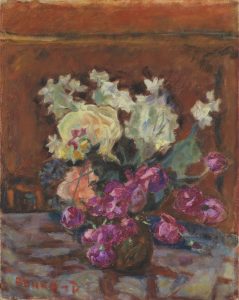

Le Bouquet de Roses–Femme Accoudée
Henri Matisse
1920
- YEAR:1920
- MEDIUM:Oil on canvas
- DIMENSIONS:33 × 41 cm
Introduction
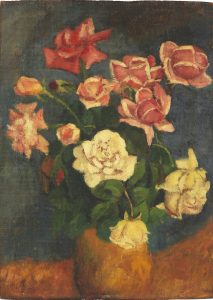
Henri Matisse, the leader and founder of Fauvism, moved to Nice in 1917, thus the pivotal “Nice Period” was unfolded in his oeuvre. The light and shadow environment of the French Riviera prompted a transformation in his painting style, and this work is a prime example of that phase. Matisse abandons the depiction of window imagery and natural light sources, while the structure, sense of light, and space in his painting all arise from the blending and collision of colours. The reclining woman and the bouquet of roses in the foreground are given equal importance, jointly forming the visual focus. The juxtaposition of colours creates a uniformly luminous effect, unifying the tones and diminishing the sense of volume and depth, which enable all elements to achieve harmony within the inherent order of colours. This demonstrates Matisse’s extraordinary genius in defining structure through colours and reconstructing space through light.